
To combat chloride pollution in the watershed, the South Washington Watershed District will provide free grit this winter. Chicken grit, or grit, is a chloride-free, non-chemical alternative to salt for deicing roads, sidewalks, and driveways during the winter.

What is grit?
Grit, also known as cherry stone grit or traction grit, is 100% natural quartzite.
Where can I pick up grit?
Free grit is located throughout the District and is currently available as long as supplies last. A list of participating cities is below. District residents are not restricted by the city, and are welcome to pick up from any location within the District. Some pickup locations are only accessible during business hours and are not open on weekends.
24 Hour Outdoor Pickup
Woodbury Public Works – 2300 Tower Dr, Woodbury, MN 55125
Click to view the Woodbury pickup location


Cottage Grove Public Works – 8635 W Point Douglas Rd S, Cottage Grove, MN 55016
- The shed is located behind the main building at the intersection of 95th St S and Irwin Ave S
- Link to coordinates
Click to view the Cottage Grove pickup location

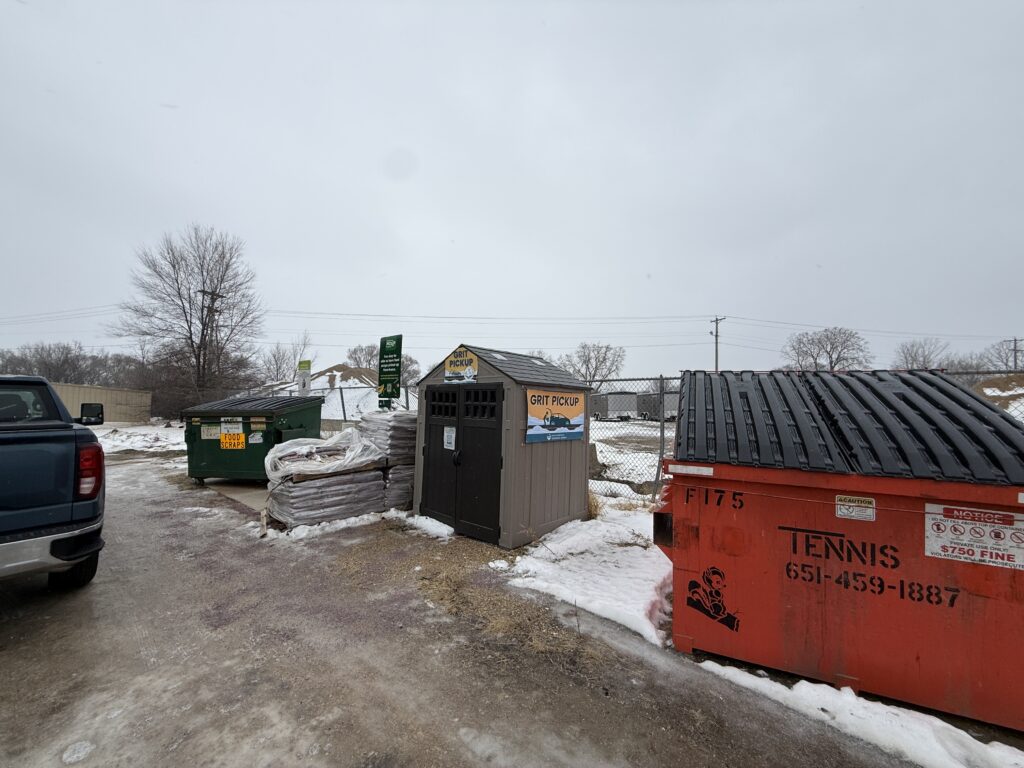
Weekday Pickup Only
St. Paul Park Streets Department – 649 5th Street, St. Paul Park, MN 55071
- Open 7 a.m. – 3:30 p.m. Monday, Tuesday, Wednesday, Thursday, and Friday. Closed weekends.
Newport Public Works – 1100 Bailey Rd, Newport, MN 55055
- Open 7 a.m. – 3:30 p.m. Monday, Tuesday, Wednesday, Thursday, Friday. Closed weekends
Open Saturdays
Washington County South Environmental Center – 4039 Cottage Grove Drive, Woodbury, MN 55129
- Open Saturdays 8 a.m. to 2 p.m
- 11 a.m. – 7 p.m. Tuesday, 8 a.m. – 4:30 p.m. Thursday, 8 a.m. – 4:30 p.m. Friday
Click to view the Environmental Center pickup location

How does grit work?
Grit works physically to provide traction on top of ice, unlike deicers, which rely on a chemical reaction to melt ice. It can also be used throughout the winter, unlike salts that chemically do not work once the ground has reached 15°F, no matter how much salt is applied.
Apply grit like how you would apply salt. Sweep up excess grit and spread it around in high-traffic areas like sidewalks and driveways. Grit doesn’t disappear, so it can be reused and moved as needed.
Grit provides immediate results, with no advanced application or waiting around for salt to begin working. Since grit does not melt ice, it also won’t create any slush in your walkway, which can later freeze and make surfaces even more slippery!
Unlike salt, grit will not stain or damage concrete surfaces.
How do I apply grit at home or at my business?
To apply grit at home, just remember to Shovel. Sprinkle. Sweep. Repeat!
Applying grit at homes or businesses is similar to applying salt. Start by shoveling to maintain your surfaces early and often to prevent accumulation. Then sprinkle your grit onto icy surfaces. Remember to apply grit on top of ice or slippery hardpack snow to create the traction layer between your feet and the ice. As temperatures fluctuate, sweep up your grit and return it to a container. Unlike salt, grit can be reused throughout the winter and from season to season! Finally, repeat this process as things get icy.
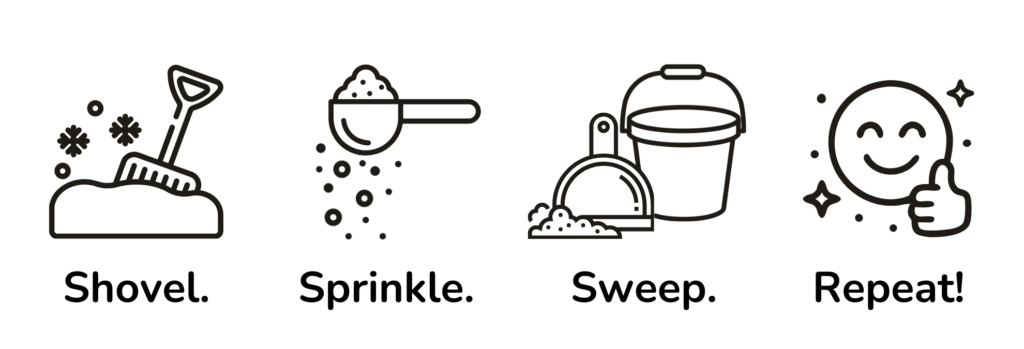
Applying Grit
- Shovel. Shovel early, shovel often. This eliminates slippery surfaces before they start.
- Sprinkle. Sprinkle grit liberally onto slippery outdoor surfaces. It is not recommended to apply grit to marble surfaces.
- Sweep. As snow and ice melt, sweep up the grit and put it into a container for future use.
- Repeat! When things get icy, grab the grit and repeat. Your local lake thanks you!
Why is chloride a problem?
In high amounts, chloride can be toxic to fish, amphibians, and aquatic bugs. Even at low levels, too much chloride can negatively impact species diversity and productivity.
Chloride can also affect pets. When pets consume salt, by licking salt off their paws, or drinking salty snow melt or runoff, it can make them sick. It can also irritate paw pads.
Wildlife can also be impacted by chloride. Songbirds, like house sparrows and finches, can die when they ingest salt.
When road slush accumulates on the roads, salty splashes can kill plants and trees along the roadside. Many plants can take up salty runoff through their roots, harmful to the plants. Aquatic plants are also heavily impacted when chloride enters streams, lakes, and wetlands.
Soil can lose its ability to retain water and store nutrients when polluted with salt. This makes soil more prone to erosion and sediment runoff, which is already harmful to water quality.
Chloride is also corrosive to paved surfaces (hence why there are only two seasons in Minnesota: Winter and construction). It damages bridges and reinforcing rods, increasing maintenance and repair costs. Tip! To preserve your investment, avoid applying salt to recently paved driveways, sidewalks, or patios.
What does chloride pollution mean for me?
Chemical deicing products have polluted our lakes, streams, and wetlands with chloride, and once chloride gets into water, it’s there for good and will build up year after year. It only takes one teaspoon of salt to permanently pollute five gallons of water, and in Minnesota, we spread around 445,000 tons of it on our roads each year. To put it into perspective, that’s the equivalent weight of 1,017 jumbo jets, 67,283 African Bush Elephants, or 651,124,531 basketballs.
Chloride also pollutes groundwater, impacting not only the taste but the healthfulness of our drinking water. Around 75% of Minnesotans rely on groundwater for drinking water.
FAQs
Will grit melt ice?
No. Grit will not melt ice. Grit acts as traction on top of grit.
Is grit safe for pets?
Yes. Salt can cause skin irritation to pet paws and even make them sick if ingested, often through licking paws clean. Grit is just chipped rock, similar to a gravel road; if you are comfortable with your pets walking on gravel, then you can feel comfortable letting them walk on traction grit.
Can I apply grit over deep snow?
It is not recommended to apply grit on top of deep snow, as it won’t work as intended. Remember to first shovel before you sprinkle salt onto icy surfaces.
What happens if I don’t sweep up my grit?
If grit is not swept up, it may become frozen into the ground or frozen over as temperatures rise and fall. If this occurs, simply apply more grit and wait for a thaw to collect all the grit.
How should I store my grit?
Grit can be stored for the long and short term in any plastic container, cardboard box, or the original bag it came in.
Will grit damage my snow plow or lawn mower?
Each grit granule is approximately 3/16th of an inch in size. If you are concerned about potential damage to machinery, please consult your machinery manufacturer.
Questions? Call or email Abby Tekiela, Water Resources Program Coordinator, at [email protected], (651)-728-6827