

Could harvesting biomass of cattails reduce nutrients and improve water quality in Armstrong Lake? The South Washington Watershed District has launched a pilot program to find out.
Cattails are a species staple of Minnesota lakes and ponds. The aquatic plant grows tall and dense, quickly dominating shoreline environments. While cattails may all look the same at first, there are actually three species of cattail present in Minnesota: the native broadleaf cattail (Typha latifolia), the nonnative/introduced narrowleaf cattail (Typha angustifolia), and the hybrid cattail (Typha x glauca).
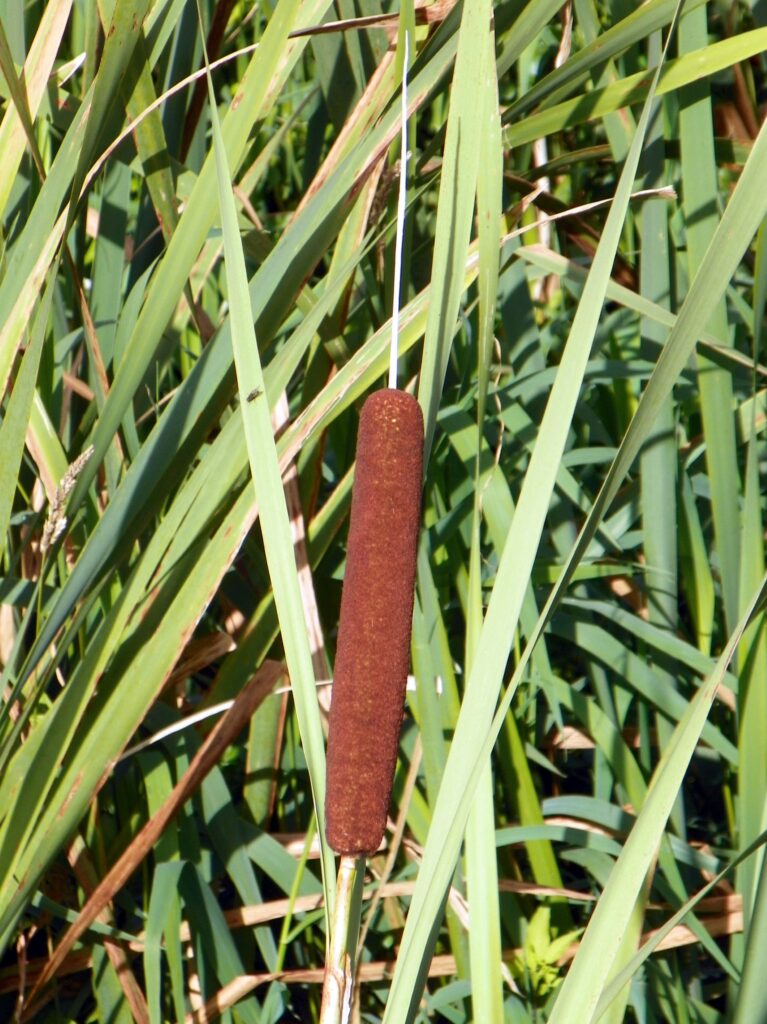
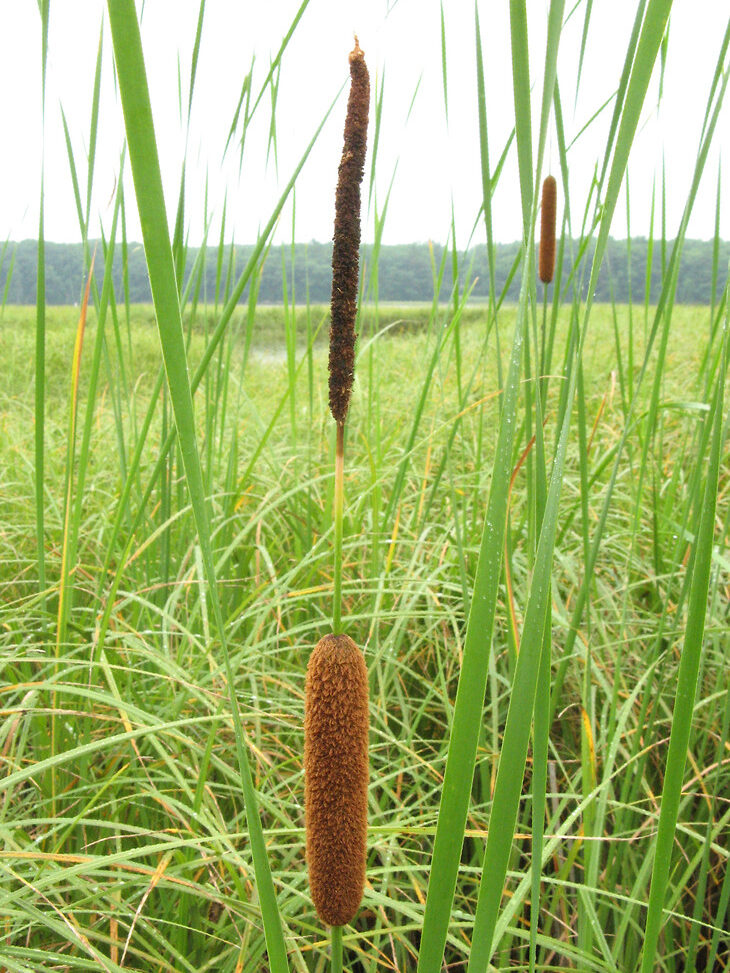
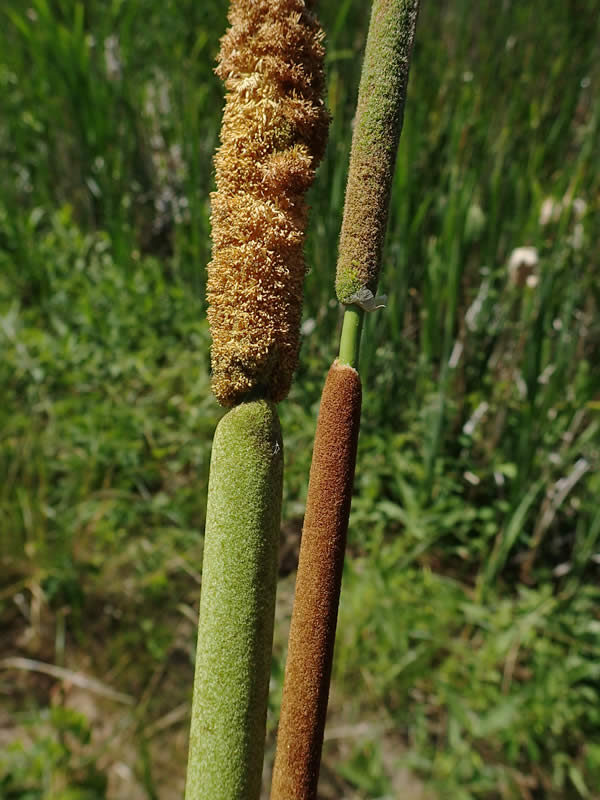
Like all plants, Cattails require nutrients like phosphorus and nitrogen to grow. When nutrients are abundant through runoff, plant growth can really take off. This is the case in Armstrong Lake and Armstrong wetland in Oakdale, where the directly adjacent impervious surfaces of the roadways and neighborhoods result in nutrient-rich runoff. While it is important for ecological function to have some amount of nutrients in the water and soil, having too much can trigger ecological dysfunction.
As the cattails grow, they take up available nutrients in the water and soil like a sponge. Cattails are particularly good at uptaking phosphorus, and can store anywhere from 10-25% of total P in the above-water portion of the plant.1
The nutrients are then stored within the biomass of the cattail, or the total organic matter of the plant. By the end of the growing season, when the cattail has fully matured, the plant will begin to die back. As it dies, its leaves, stalk, seeds, and rhizome, or the plant’s biomass, decompose and reenter the water and sediment. When this happens, all the nutrients that the cattail once took up are now rereleased into the ecosystem. This is a natural process, and under normal conditions, it is an essential part of the nutrient cycle. However, with human activity, nutrient loading from stormwater runoff is excessive, leading to poor water quality.
To prevent nutrient-dense cattail biomass from reentering Armstrong Lake, SWWD is undertaking a pilot program to assess the potential for total phosphorus reduction through the removal of cattail biomass. Over time, harvesting cattail biomass will reduce the amount of phosphorus being added to the existing waterbody, thereby reducing overall phosphorus in the water and sediment. If, after laboratory testing, this process is deemed successful, water quality would improve, and the process would be conducted on a larger scale.
Data from Armstrong Lake & Armstrong Wetland
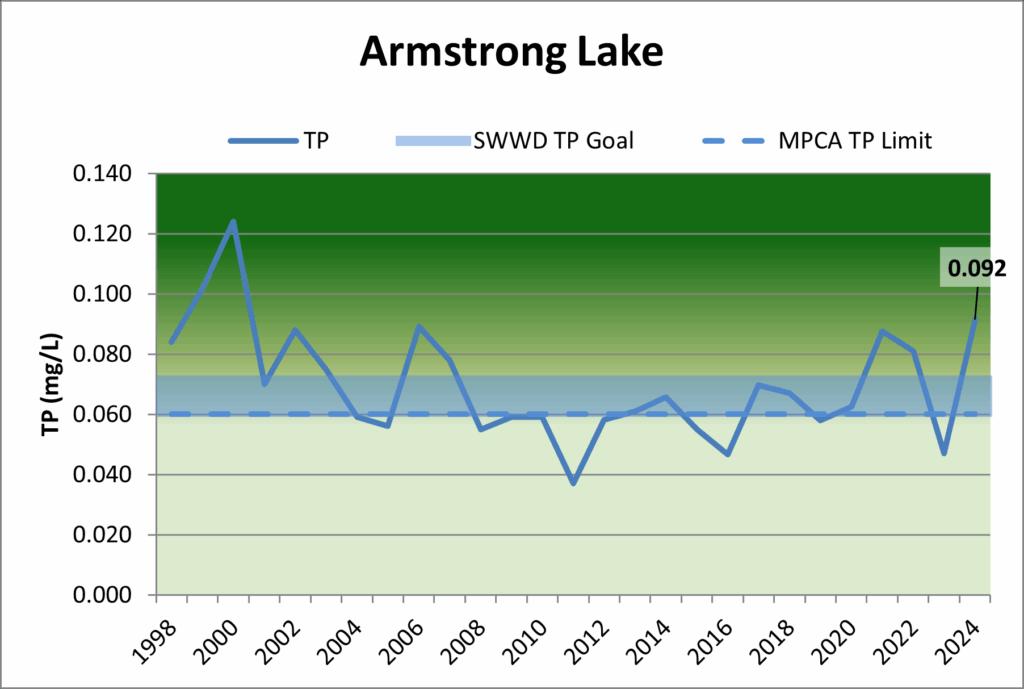
Water quality is monitored at Armstrong Lake & Armstrong wetland. The data shows that TP, or the Total Phosphorus, has fallen above and below the SWWD goal of 0.060-0.070 mg/L throughout the last two decades.
Total Phosphorus is also impacted by warmer or colder winters, and more or less annual precipitation.
How will the harvest be conducted?
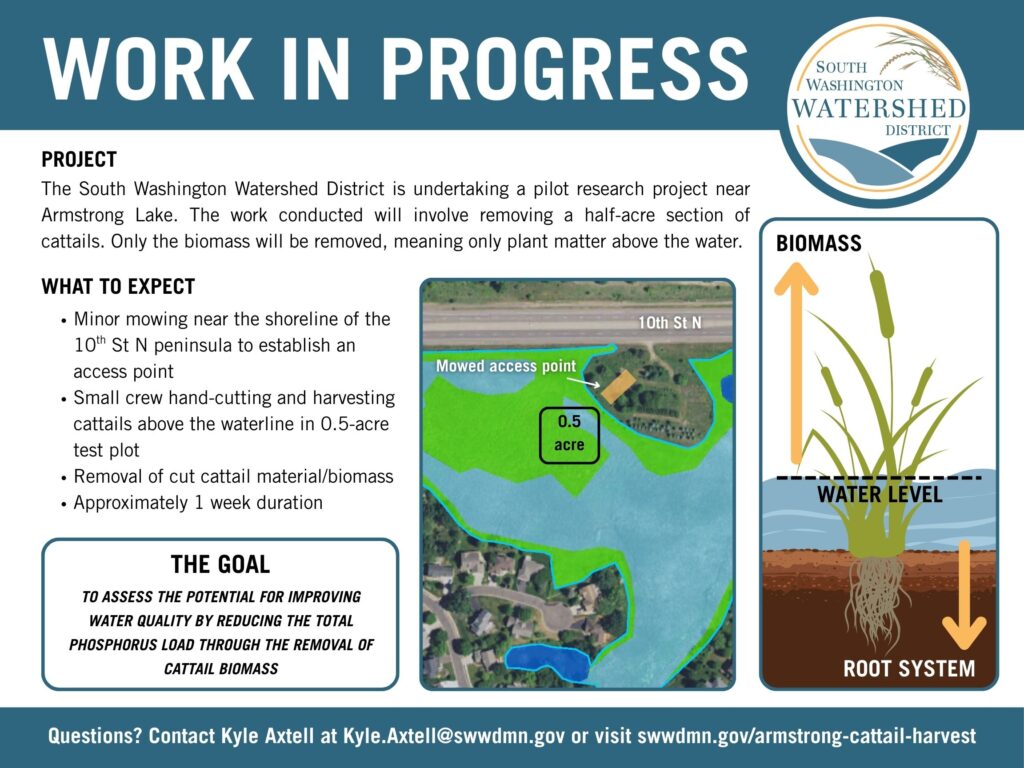
Harvest will occur during August, the peak growing season. The amount of phosphorus (P) stored during peak growth season in August ranges from 44 lbs of P per 2.5 acres up to 132 lbs of P per 2.5 acres.2 Crews will enter Armstrong wetland from the south side of 10th Ave N from a city-owned peninsula. With the support of our partners at the City of Oakdale, a small patch of grass will be mowed to allow the work crew access to the 0.5-acre patch that will be harvested. Only the above-water biomass will be harvested, and the collected materials will be fully removed from the site.
Where will the harvested biomass go once removed from the site?
Portions of the biomass will go to a laboratory for sampling. This will provide insight into the amount of phosphorus the cattails are storing. Water quality will be continuously monitored throughout the next year and compared to past data to determine the extent of phosphorus reduction. The remaining plant material will be brought to a landfill for disposal. While it would be ideal to compost organic materials, cattails also absorb chloride. Armstrong Lake and Armstrong wetland already have high levels of chloride, likely due to the proximity to winter-salted roads. Landfill disposal was determined to be the most effective option for minimizing the risk of compost contamination.
Chloride pollution is a growing concern across the state of Minnesota. The application of winter road salts is the number one cause of chloride pollution, contributing to groundwater contamination, environmental degradation, and infrastructure damage. 3
What should I expect to see?
- Expect to see minor mowing near the shoreline of the 10th St N peninsula to establish an access point
- Small crew hand-cutting and harvesting cattails above the waterline in a 0.5-acre test plot
- Removal of cut cattail material/biomass
- Approximately 1 week of work at the end of August 2025
Questions? Contact Kyle Axtell, Watershed Project Manager, [email protected]
Footnotes
- Grosshans, Richard & Venema, Henry & Cicek, Nazim & Goldsborough, L.. (2011). Cattail Farming for Water Quality: Harvesting Cattails for Nutrient Removal and Phosphorous Recovery in the Watershed. Proceedings of the Water Environment Federation. 2011. 1107-1132. 10.2175/193864711802867478. ↩︎
- Grosshans, et al. (2011) ↩︎
- Chloride. Minnesota Pollution Control Agency. (n.d.). https://www.pca.state.mn.us/pollutants-and-contaminants/chloride ↩︎