

The South Washington Watershed District and the City of Newport will proceed with a restoration project at the Bailey School Forest, which will begin in fall 2025.
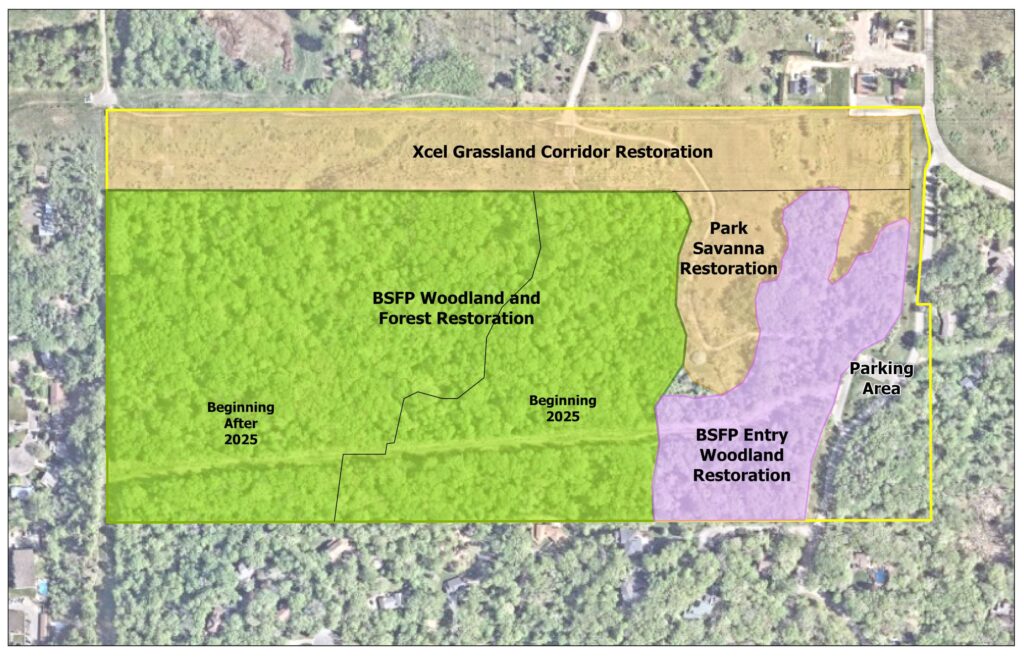
Bailey School Forest Park is a significant area located along the Mississippi River bluffs. The grassland, woodlands, and forest have become largely dominated by invasive and non-native species. Over the coming years, the South Washington Watershed District and the City of Newport will collaborate with state and local partners to transform the park’s wooded areas into a thriving natural plant community that supports native wildlife, healthy waters, and rebuilds soil ecosystems.
Restoration of the Entry
In fall 2025, restoration of 9 acres at the entry of Bailey School Forest will begin. There will be significant restorative efforts made to return the woodland to a more natural space and establish a more resilient plant community.
What to expect
- Forestry mowing will remove the thick undergrowth of predominantly non-native and aggressive shrubs
- Crews will be thinning the tree canopy to provide light to sensitive understory species. Removal will focus on hazardous trees, trees growing too densely, and non-native & noxious species.
- Expect to see grazing goats, native grasses and flowering seeds, tree canopy thinning, and biochar kilns that will reduce the carbon impacts of brush burning.
What is biochar?
During a land restoration project, a large amount of biomass waste is generated. Traditionally, the waste is disposed of through open-pile burning, which releases greenhouse gases and degrades air and soil quality.
Biochar is a low-carbon alternative to open-burning disposal, and is used as a way to reduce greenhouse gases, reduce air pollution, and minimize damage to soils where the burn takes place. The charcoal that is produced during a biochar burn, sometimes described as “supercharged charcoal”, is different than the charcoal that is produced in a traditional burn. This supercharged charcoal is a form of carbon sequestration, and can lock up to 80% of the carbon in a solid form, preventing it from re-entering the atmosphere as carbon dioxide.
Why are goats used during a restoration?
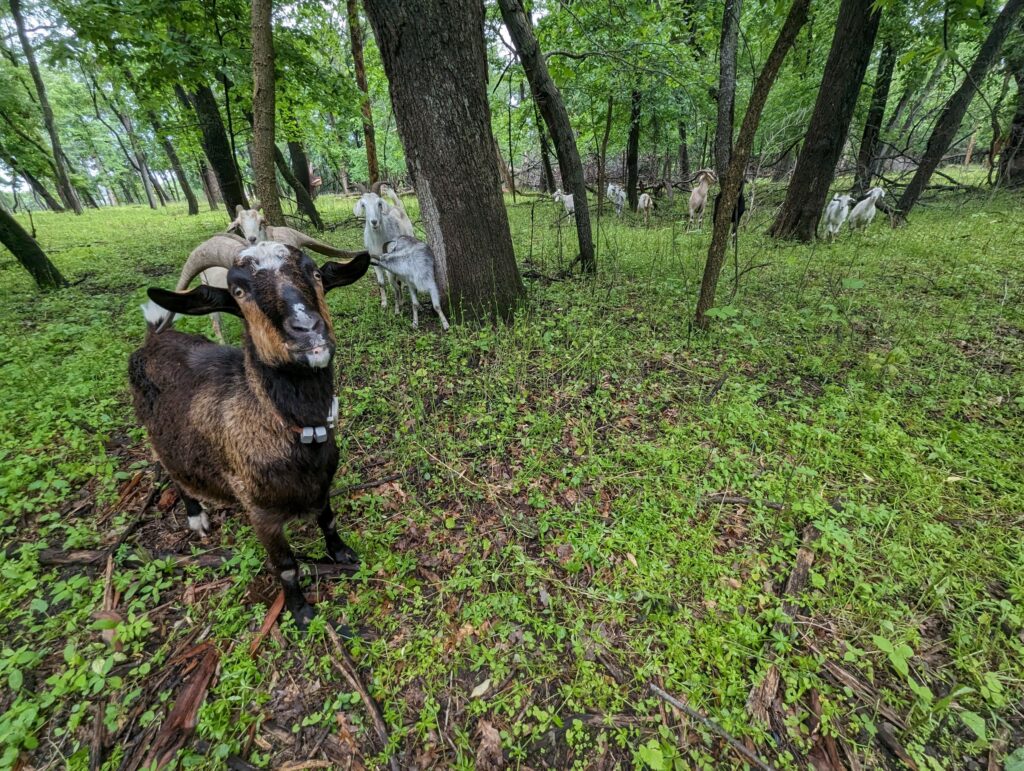
Simply put, goats are eating machines. Goats have a willingness to chow down on almost anything in their path, from buckthorn to sumac, making them a powerful (and adorable) partner in the restoration process.
Goats can manage the growth of plants, preventing the plant from getting any bigger or spreading. They are also fast and agile, and able to access and clear land that humans with hand tools or large machinery can’t get to. Goats also help with the problem of biomass waste that is generated during a restoration project. To a goat, a restoration site is like an all-you-can-eat buffet!
Questions? Contact Tony Randazzo, Watershed Restoration Specialist, [email protected]